
Under-the-radar Nordic destinations for 2027

The Nordic region has a quieter alternative to almost every famous place. Below are eight under-the-radar destinations to visit in 2027, and why to go now.
The Nordic region has a quieter alternative to almost every famous place, and 2027 is a good year to find them. Lofoten in July, the Golden Circle at midday, Rovaniemi before and around Christmas: these are wonderful, and they are also busier than they were. None of that is a reason to stay away. It is a reason to look slightly to one side.
What follows is a Nordic bucket list of a different kind. Not the loudest sights, but the under-the-radar destinations next to them, places with the same coastline, the same wildlife, often the same weather, and more room to take it in. Each is genuinely less visited than its famous neighbour. Each can take a few more travellers without strain. And each has a real reason to go in 2027, a new railway, a returning festival, or simply a season that suits it.
This is not a ranking, and it is not only for winter. Some of these places are best under the midnight sun, others in the dark months when the aurora is out. We have said which is which, so the list works whenever you are planning to travel.
At a glance
| Where to go | Instead of | Best season | Why 2027 |
|---|---|---|---|
| Vesterålen, Norway | Lofoten | Summer & winter | Same coast and whales, far fewer cars |
| Westfjords, Iceland | Golden Circle & Ring Road | Summer | Iceland before the crowds, remote and quiet |
| Bornholm, Denmark | Copenhagen | Summer | Baltic island barely known outside Scandinavia |
| Southern Faroes (Suðuroy) | Tórshavn day-trip sights | Summer | Remote islands, home dining with locals |
| Kiruna, Sweden | Rovaniemi | Winter (summer for hiking) | Aurora, plus a whole town being moved |
| Ranua, Finland | Rovaniemi | Winter | Lapland essentials near the new cross-border line |
| Liepāja, Latvia | Riga | Year-round | European Capital of Culture 2027 |
Vesterålen, Norway
Lofoten has become one of the most photographed coastlines in Europe. Vesterålen, immediately to the north, shares the same peaks and fishing villages with a fraction of the summer traffic. This is whale country: humpbacks and sperm whales feed offshore, sea eagles work the cliffs, and the islands reveal themselves slowly rather than all at once. You drive a little further and meet far fewer people. Good in summer for whales and the midnight sun, good in winter for the lights.
Our itinerary: Whales and Villages in Lofoten and Vesterålen, a new self-drive journey for 2027 running from Vesterålen into Lofoten, with whale watching from Andenes.

The Westfjords, Iceland
Most of Iceland's visitors keep to the south and the Ring Road. The Westfjords, the oldest and most remote corner of the country, are largely left alone. This is what Iceland looked like before the crowds arrived: sparsely populated, wind-scoured, folded with fjords and seabird cliffs. Látrabjarg holds Europe's largest bird cliff. Dynjandi falls in seven tiers. Harbour towns still run to the rhythm of the day's catch. A summer journey, when the roads are open and the light is long.
Our itinerary: Iceland Westfjords self-drive. For a gentler route closer to Reykjavík, the Snæfellsnes and North Iceland self-drive reaches the same glaciers, wildlife and hot springs at an easier pace, and skirts the Golden Circle crowds.

Bornholm, Denmark
Copenhagen is one of the region's most visited cities. Few of its visitors carry on to Bornholm, the sunny Baltic island a bridge and a ferry to the east. Danes, Swedes and Norwegians know it well; it is little known beyond Scandinavia. That is the appeal. This is a place to meet locals rather than other travellers, with rocky shores, smokehouses, round churches and Hammershus, the largest medieval fortress ruin in Northern Europe. A summer island, best from June to September.
Our itinerary: Bornholm summer tour.

Suðuroy and the southern Faroes
The Faroe Islands are no longer a secret, and the best-known sights now draw a crowd in summer. The quieter reward lies south, on Suðuroy, reached by a two-hour ferry most day-trippers never take. Here the pace changes: cliff-top walks, a village guesthouse, and meals eaten in a local family's home under the Faroese tradition of heimablídni. Less a place to tick off than one to be taken in by. A summer journey, roughly May to August.
Our itinerary: Local Secrets of the Faroe Islands.

Kiruna and Swedish Lapland
For aurora and Arctic winter, Rovaniemi carries most of the traffic. Kiruna, over the border in Swedish Lapland, offers the lights with a story attached. The town centre is being relocated east to let the iron-ore mine beneath it expand, and in August 2025 its 1912 wooden church was moved, whole, about five kilometres to the new centre. Around it sit the Icehotel at Jukkasjärvi, the aurora skies of Abisko and Kebnekaise, Sweden's highest peak. It is now reachable overland from the Finnish side, too, on the reopened cross-border railway. One note of care: this is Sápmi, and the move has pressed hard on Sámi reindeer herders. It is better understood as a story of adaptation and its costs than as spectacle. A winter destination for the lights; summer brings the midnight sun and the hiking.
Our itinerary: Aurora Safari in Swedish Lapland.
Ranua, Finland
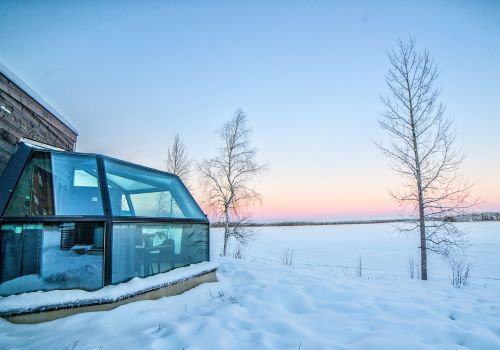
Ranua offers the essentials of a Lapland winter, huskies, reindeer, Santa and a glass igloo under the aurora, without the concentration of the biggest hubs. It sits south of Rovaniemi and makes an unhurried base for a family, anchored by its wildlife park. It also benefits from the most quietly significant piece of Nordic travel news in years: in August 2026, cross-border rail returned between Finland and Sweden for the first time in nearly 40 years, linking northern Finland to the Swedish network and on towards Stockholm. The line reaches the border at Tornio and Haparanda rather than Ranua itself, but it brings a genuine flight-free route into Lapland within reach.
Our itinerary: Swedish and Finnish Lapland in winter, a new family journey for 2027 that travels by rail from Luleå to the border town of Haparanda, where cross-border trains to Finland returned in 2026, then continues to Ranua, spreading the nights across Brändön, Haparanda and Ranua rather than one busy base.
Ruka and Kuusamo, Finland
A quieter winter base than Levi, over in Finland's east. The reason to go in 2027 is specific: the Polar Night Light Festival turns the slopes and forests of Ruka into an open-air work of light art through the darkest weeks of the year. It gives a reason to travel in deep winter for something beyond the aurora alone.

Liepāja, Latvia
One place on this list sits just outside the Nordic region, and earns it. Liepāja, on Latvia's Baltic coast, is a European Capital of Culture for 2027, with a year-long cultural programme under the theme (un)rest. A windswept city of Art Nouveau streets, a long white beach and Soviet naval history, three hours from Riga and almost unknown to most travellers. For anyone curious about where the Nordic and Baltic worlds meet, this is the year to go - and we can organise the trip for you.

A thread through the north: two railways return
Part of what makes 2027 the year for several of these places is how much easier they have become to reach without flying. In June 2026, Snälltåget began running a daytime train between Malmö, Gothenburg and Oslo, opening the southern corridor to slow travellers. Two months later, cross-border rail returned between Finland and Sweden after nearly four decades. Together they make it possible to reach Lapland overland, and to stay in the quieter places along the way rather than heading straight for the busiest hub.
A closing thought
Travelling to one side of the icons is not a sacrifice. More often it is the better trip: quieter, slower, closer to the people who live there. It is also how these places stay worth visiting. A few corners of the north, the high Arctic among them, are best seen rarely and lightly, if at all. The rest of this list is an invitation to go, just slightly to one side of where everyone else is going.
About the author
Satu Vänskä-Westgarth is Director of Product at 50 Degrees North. Finnish, and living in Norway for close to 20 years, she has worked across the travel industry, from raft guiding and travel writing to product strategy, and designs the company's Nordic journeys around authentic, local experiences. She knows the quieter corners of the north first-hand. A keen photographer, she travels widely across the Nordic and Baltic region, from Lofoten to the Faroe Islands and Greenland, and is drawn to the places just off the usual route: the island reached by the later ferry, the town most people drive past. This article comes from that way of travelling. Read more about Satu.