
Best time for Northern Lights in Finland
Finland is well known as a 'Northern Lights' travel destination. Above the Arctic Circle, small villages and resorts in the wilderness over unique chances to see the lights between mid-September to early April.
Finland is one of the world's most reliable places to see the Northern Lights. Above the Arctic Circle, small villages and wilderness resorts offer good chances of seeing the aurora from around late August to early April, when the nights are dark enough for the lights to show. Seeing them takes a little planning and a little luck, and as locals, we can help you do both: find the aurora, and have a rewarding holiday in our region at the same time.
What time of year can you see the Northern Lights in Finland?
The Finnish Lapland aurora season runs from roughly late August to early April. Outside this window, from May to July, the midnight sun keeps the sky too bright for the lights to be visible, even though the aurora is still occurring overhead.
The ideal conditions are a clear, dark sky and cold, dry air, which is why the inland valleys of Lapland, away from the coast, are so well suited. Two things need to line up: you need to be under the auroral zone, which sits over northern Finland, and there needs to be enough solar activity on a clear night. The good news is that this far north you don't need a major solar storm; ordinary low-level activity is often enough. Activity also tends to peak around the spring and autumn equinoxes, around 20 March and 20 September, which can make displays especially strong.
Where are the best places to see the Northern Lights in Finland?
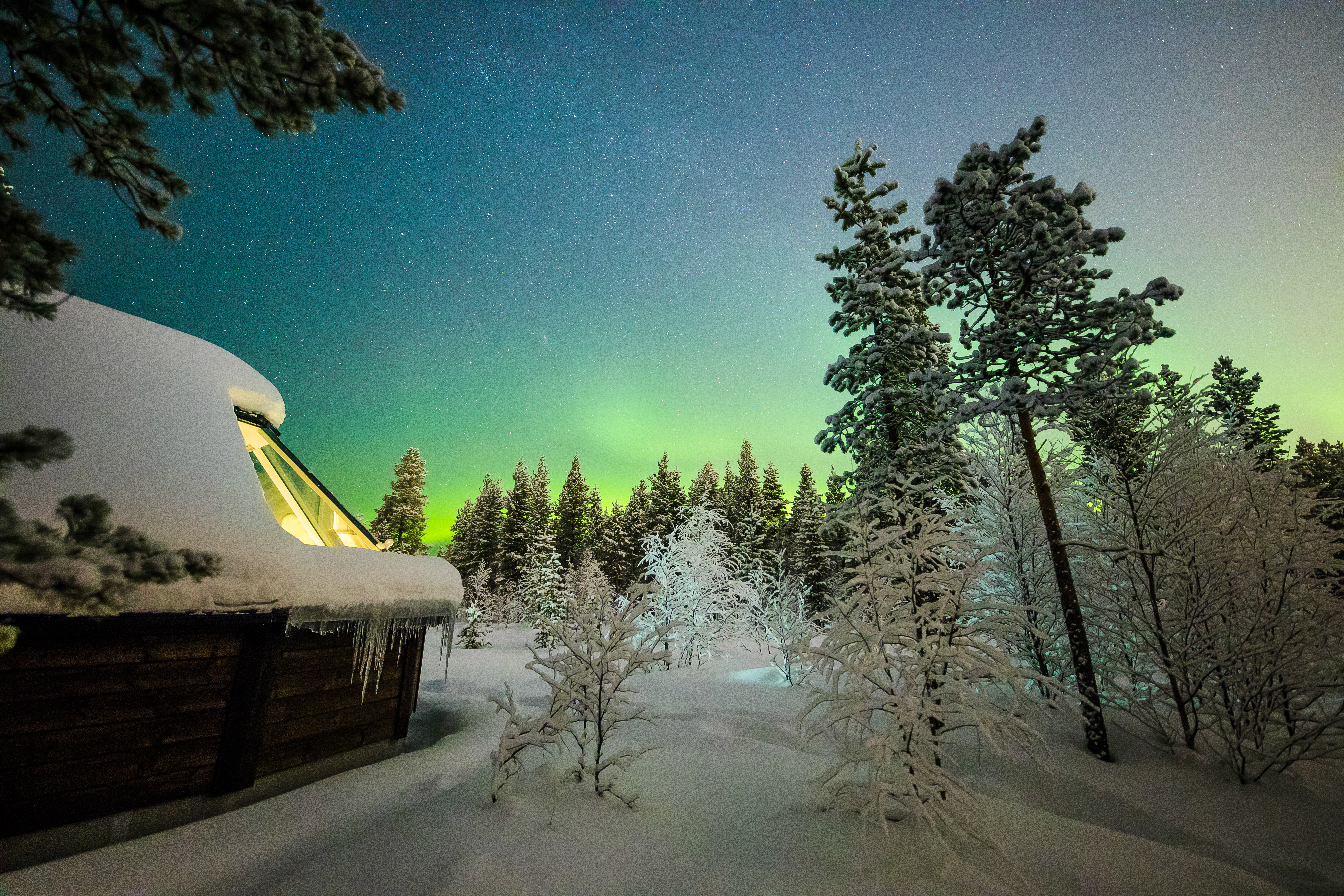
The essential ingredient is a clear night with no light pollution. Larger towns such as Rovaniemi can offer viewing, but on most nights you'll want to head out of town to escape the town lights. This is one reason glass igloos and Aurora cabins have become so popular in Finland: many sit on the outskirts of villages, in genuinely dark surroundings, letting you watch the sky from your bed. If you choose one, it's worth checking how far apart the cabins are, since a cluster of them can throw out light too. You can read more about staying in glass igloos in Finland.
Remember that the aurora can't be taken for granted. It's a natural phenomenon, like the weather: it occurs when charged particles from the sun collide with oxygen and nitrogen in the Earth's atmosphere, and both the solar activity and the clear sky have to cooperate.
Can you see the Northern Lights in autumn?
Yes. In September, October and November you have a real chance of the aurora above the Arctic Circle, and autumn has its own advantages. With no snow yet on the ground, the season is milder and quieter, good for hiking, berry picking and exploring by day. Because you're inland, you also miss the autumn storms that hit the coast. The lakes are still unfrozen, which makes for striking aurora reflections on the water, and evenings can be spent by a campfire waiting for the lights, or watching them from an Aurora cabin. As November approaches, the days shorten quickly to just a few hours of light.
For an autumn trip, good starting points include Aurora Highlights in Autumn, Autumn Northern Lights in the Arctic and Northern Lights in Autumn at the Aurora Village. Several of our small group tours also have autumn departures that travel above the Arctic Circle.
Can you see the Northern Lights in winter?
December, January and February are the heart of the aurora season, with the longest, darkest nights of the year. This is also Santa season, which is worth planning around. Popular areas can be busy and congested at this time, accommodation and activities book up well ahead, and flights are pricier and harder to find. If your priority is the Northern Lights rather than meeting Santa, we suggest smaller resorts off the beaten track, such as the Sunday Morning Resort or a stay in a wilderness hideaway, where the skies are darker and the crowds thinner. Browse our full range of Northern Lights trips, or see our small group tours for winter departures that travel above the Arctic Circle.
Can you see the Northern Lights in spring?
Yes, March and April still offer good aurora viewing, and the equinox around 20 March often brings strong activity. By May the season is effectively over, as the daylight hours lengthen quickly and the nights are no longer dark enough. Spring has the advantage of much longer days than midwinter, so it suits travellers who want to combine aurora nights with active days: late-season skiing, wildlife or wilderness adventures. Glass igloos are also easier to book at this time of year. See our Northern Lights trips, or our small group tours for spring departures.

Can you see the Northern Lights in Helsinki?
Very rarely. It might happen once or twice a year, but the displays are usually faint and hard to see. Helsinki's light pollution and its southerly location, well below the auroral zone, make sightings unusual. To see the Northern Lights reliably in Finland, you need to travel north, above the Arctic Circle.

How to read the Northern Lights forecast
Before and during your trip, aurora apps and websites show a forecast a few days ahead, based on the Kp index, a 0 to 9 scale of geomagnetic activity. In northern Finland you don't need a high number: because Lapland sits under the auroral zone, the lights can appear at Kp 1 to 2, which is among the most common levels. The Finnish Meteorological Institute publishes a space weather page, and local aurora apps are widely used. A forecast tells you when conditions are promising, but a clear sky on the night is just as important, which is why staying several nights improves your chances.
Frequently asked questions
How many nights should I stay to see the Northern Lights in Finland?
We'd suggest at least three or four nights above the Arctic Circle, and ideally five to seven. Any single night can be clouded out, so more nights simply means more chances. Building a trip around several nights in the north, rather than one stop, is the single best thing you can do.
Are the Northern Lights guaranteed?
No. The aurora is a natural phenomenon that depends on both solar activity and clear skies, so no tour can promise it. The best approach is to book a trip you'll enjoy regardless, with good accommodation and activities, so that even on a cloudy night you've had a rewarding break, and to give yourself several nights for the sky to cooperate.
What's the best month for the Northern Lights in Finland?
There's no single best month, but September to October and February to March are often considered the sweet spot, balancing dark skies with milder temperatures and strong equinox-period activity. Midwinter has the darkest, longest nights but the coldest, busiest conditions.
Do I need a tour, or can I see them independently?
You can see the aurora independently if you have a car and know where to find dark skies, but a local guide improves your odds considerably, knowing which direction to head each night for the clearest conditions. Many of our Finland stays include guided aurora outings.
Can you photograph the Northern Lights on a phone?
Yes. Modern phones with a night mode capture the aurora well, often showing colour the eye can barely detect. Use night mode or a long exposure, keep the phone steady, and turn off the flash.
Ready to plan a trip?
Browse our full range of Northern Lights tours, or read more about staying in glass igloos in Finland.
Image credits: Beyond Arctic, Aurora Village Ivalo, and Harriniva Adventure Resort.